Product Overview 221 remington fireball
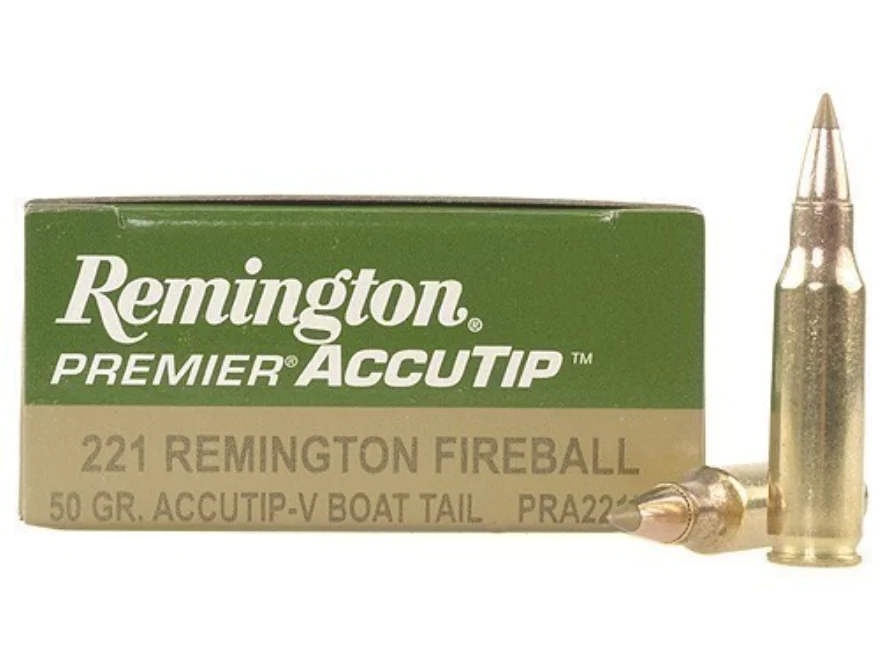
221 remington fireball Remington Premier AmmunitiΒ and hunter one of the greatest varieties of premiumΒ on offers the shooterbullet designs ever introduced, combined with strict manufacturing tolerances to create ammunition any shooter would be willing to use on that shot of a lifetime. This ammunition is new production, non-corrosive, in boxer primed, reloadable brass cases.
Specifications
Product Information
| Cartridge |
221 Remington Fireball
|
|---|---|
| Grain Weight |
50 Grains
|
| Quantity |
20 Round
|
| Muzzle Velocity |
2995 Feet Per Second
|
| Muzzle Energy |
996 Foot Pounds
|
| Bullet Style |
Polymer Tip
|
| Bullet Brand And Model |
Remington AccuTip
|
| Lead Free |
No
|
| Case Type |
Brass
|
| Primer |
Boxer
|
| Corrosive |
No
|
| Reloadable |
Yes
|
| G1 Ballistic Coefficient |
0.238
|
| Velocity Rating |
Supersonic
|
Delivery Information
|
Shipping WeightΒ |
0.545 Pounds |
|---|---|
|
DOT-RegulatedΒ |
Yes |
TheΒ .221 Remington Fireball, often simply referred to asΒ .221 Fireball, is aΒ centerfireΒ cartridgeΒ created byΒ Remington Arms CompanyΒ in 1963 as a special round for use in their experimentalΒ single-shotΒ bolt-actionΒ pistol, theΒ XP-100.[2]Β A shortened version of theΒ .222 Remington, it is popular as a varmint and small predator round while also finding use among target shooters. It has application as both a pistol round and as a rifle round.
History
In the early 1960s Remington was working on an experimental bolt-action pistol based on theirΒ model 600 action. The goal was a highly accurate pistol that would be well suited for competition.
After working with the .222 Remington they determined that it contained more powder capacity than was necessary to work efficiently in the shorter barrels of pistols. While rifle barrels commonly range in length from 14.5 to 26Β in (37 to 66Β cm), pistol barrels are typically much shorter, ranging from 2 to 12Β in (5.1 to 30.5Β cm) although occasionally up to 16Β in (41Β cm) for some competition barrels. As a result, Remington decided to develop a shorter version of the .222 Remington cartridge, optimized for use in the XP-100.
While production of XP-100 pistols chambered in .221 Fireball was eventually canceled after 1985,[3]Β Thompson Center ArmsΒ produced variousΒ single-shotΒ pistols chambered for the .221 Fireball as part of their Contender and Encore models. Rifles chambered for the .221 Fireball include the Remington 700 and the Ceska zbrojovka CZ 527.
Performance
Despite its smaller size, the .221 Fireball is capable of velocities nearly equal to that of the .222 Remington largely due to its higherΒ SAAMIΒ pressure. The maximum SAAMI pressure level for the .221 Fireball is 52,000 C.U.P. as compared to 46,000 C.U.P. for the .222 Remington. The purpose of the increased pressure was to allow it to perform more effectively in the shorter barrel of the XP-100.
The .221 Fireball produces the highest velocity of any commercial pistol cartridge.[4]
Offshoots
The .221 Fireball has been used byΒ wildcattersΒ to create a small efficient .17 caliber cartridge. The most common is theΒ .17 Mach IVΒ which is essentially the .221 necked down to the smaller caliber.
This cartridge is reported to have a very flat trajectory and to be relatively quiet with low recoil. It has been so popular as a wildcat that in 2007 Remington legitimized it by introducing their own version only slightly different from the Mach IV and calling it theΒ .17 Remington Fireball.[5]Β A .20 caliber version is also gaining popularity called theΒ .20 VarTargΒ (VT), “vartarg” being the combination of the words “varmint” and “target”. The
.221 Fireball has also been used as the base for theΒ .300 Whisper, sometimes referred to as the .300/.221 or .300 Fireball. It is also the basis for other cartridges in J.D. Jones’ Whisper family including the 6Β mm Whisper, which has been adopted byΒ Knight’s Armament CorporationΒ for their newΒ Knight’s Armament Company PDWΒ as the 6Γ35mm PDW.


Reviews
There are no reviews yet.