

Β 25-06 RemingtonΒ Β Product Overview
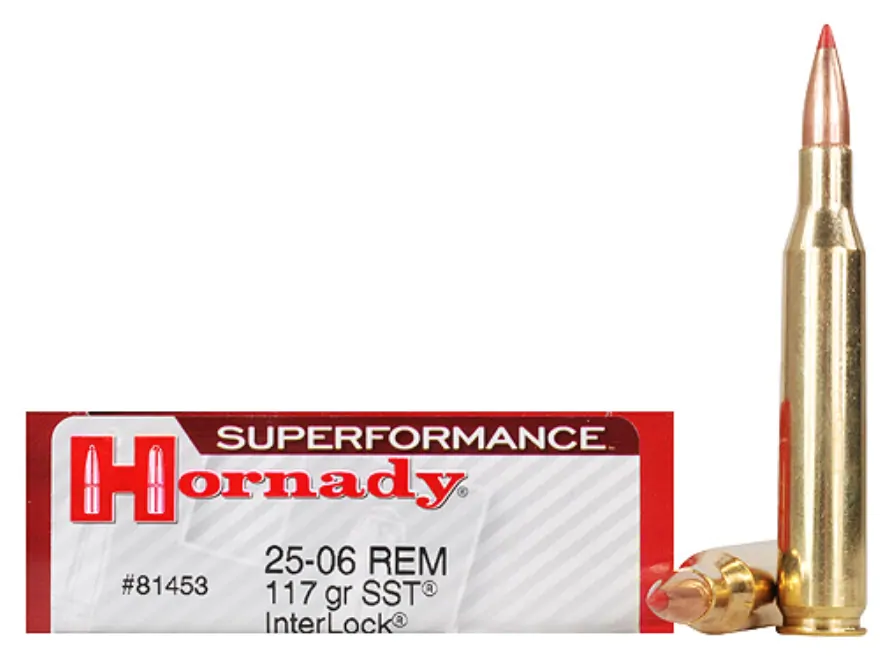
25-06 RemingtonΒ Β Superformance ammunition is loaded with proprietary propellants that increase the velocity ratings up to 200 feet per second compared to other popular brands. Because there is no increase in pressure, regardless of the caliber, there is no increase in felt recoil but there IS an increase in efficiency and high speed performance.
From sub-zero arctic temperatures to almost unbearable desert heat, Superformance ammunition can withstand any hunting condition.
Loaded with Hornady’s InterLock Super Shock Tip (SST) bullet, this round combines proven Hornady performance with a higher ballistic coefficient than available with most hunting bullets. The sharp, pointed polymer tip creates a faster, flatter shooting bullet.
With its one-piece core and jacket strengthened in critical areas, the SST delivers much more controlled expansion and superior weight retention than other tipped bullets.
Featuring Hornady’s trade mark InterLock ring system, this bullet’s core and jacket remain locked solid during expansion, creating massive wound channels.
Made InΒ United States of America
Specifications
Product Information
| Cartridge |
25-06 Remington
|
|---|---|
| Grain Weight |
117 Grains
|
| Quantity |
20 Round
|
| Muzzle Velocity |
3110 Feet Per Second
|
| Muzzle Energy |
2512 Foot Pounds
|
| Bullet Style |
Polymer Tip
|
| Bullet Brand And Model |
Hornady SST (Super Shock Tip)
|
| Lead Free |
No
|
| Case Type |
Brass
|
| Primer |
Boxer
|
| Corrosive |
No
|
| Reloadable |
Yes
|
| G1 Ballistic Coefficient |
0.39
|
| Sectional Density |
0.253
|
| Velocity Rating |
Supersonic
|
| Country of Origin |
United States of America
|
25-06 RemingtonΒ had been aΒ wildcat cartridgeΒ for half a century before being standardized byΒ RemingtonΒ in 1969. It is based on theΒ .30-06 SpringfieldΒ cartridge necked-down (case opening made narrower) to .257Β caliber with no other changes. Nominal bullet diameter is 0.257, and bullet weights range from 75 to 120 grains (4.9 to 7.8Β g).
History
Charles NewtonΒ necked down theΒ .30-06 SpringfieldΒ cartridge in 1912 to accept the 117-grainΒ .25-35 Winchester bullet.Β Newton’s early modification encouraged commercial release of a shortened case (from 63 to 49mm) as theΒ .250-3000 SavageΒ in 1915
.Β Frankford ArsenalΒ developed an experimental .25-06 duringΒ World War I; and distribution of surplusΒ United StatesΒ military equipment through theΒ Civilian Marksmanship ProgramΒ following the war encouraged independent gunsmiths to experiment with the cartridge. A. O. NiednerΒ ofΒ Dowagiac, Michigan introduced rifles for the .25 Niedner in 1920.
Β Niedner Arms Corporation retained the 17Β° 30β² .30-06 shoulder chambering .25 caliber barrels rifled with one twist in 12 inches (300 mm).
Similar cartridges were identified as the .25 Hi-Power, .25 Whelen (analogous toΒ .35 Whelen), or .25-100-3000 (to indicate the ability to achieve 3000 feet per second with a 100 grain bullet rather than the 87 grain bullet used in the .250-3000 Savage). Greater case capacity offered minimal velocity
improvement over the .250-3000 Savage case with contemporaryΒ smokeless powders. Availability ofΒ DuPont‘sΒ Improved Military Rifle (IMR)Β powders encouraged commercial release of theΒ .257 RobertsΒ using the 57mm-longΒ MauserΒ case in 1934.
Β Release of IMR 4350 in 1940 and availability of surplus 4831 powder salvaged fromΒ Oerlikon 20mm cannonΒ cartridges afterΒ World War IIΒ greatly improved performance of the full-length .25-06 case.
.25-caliber bullets typically have high ballistic coefficients without being heavy. This characteristic, when combined with the large case capacity of its parent .30-06 case, allows relatively high muzzle velocities without heavy recoil.
The combination of high ballistic coefficients with high muzzle velocities give the .25-06 a very flat trajectory as well as retaining kinetic energy down-range.
The .25-06 is generally considered to be a good round for medium-sized game such asΒ deerΒ andΒ antelopeΒ because of its combination of substantial kinetic energy and moderate recoil.
The addition of a flat trajectory makes it particularly popular in plains states where the open fields can require longer-range shots on game, as this flatness tends to minimize range-estimation errors by the hunter.
However bullet types and weights are loaded that allow the .25-06 to be used for taking game ranging from small animals likeΒ prairie dogsΒ andΒ coyotesΒ to heavierΒ elk.
These bullets range from lightly constructed 75-grain bullets with muzzle velocities in the 3,700Β ft/s (1,130Β m/s) range to more robust 120-grain bullets with muzzle velocities in the 3,000Β ft/s (915Β m/s) range.


Reviews
There are no reviews yet.