

TulAmmo
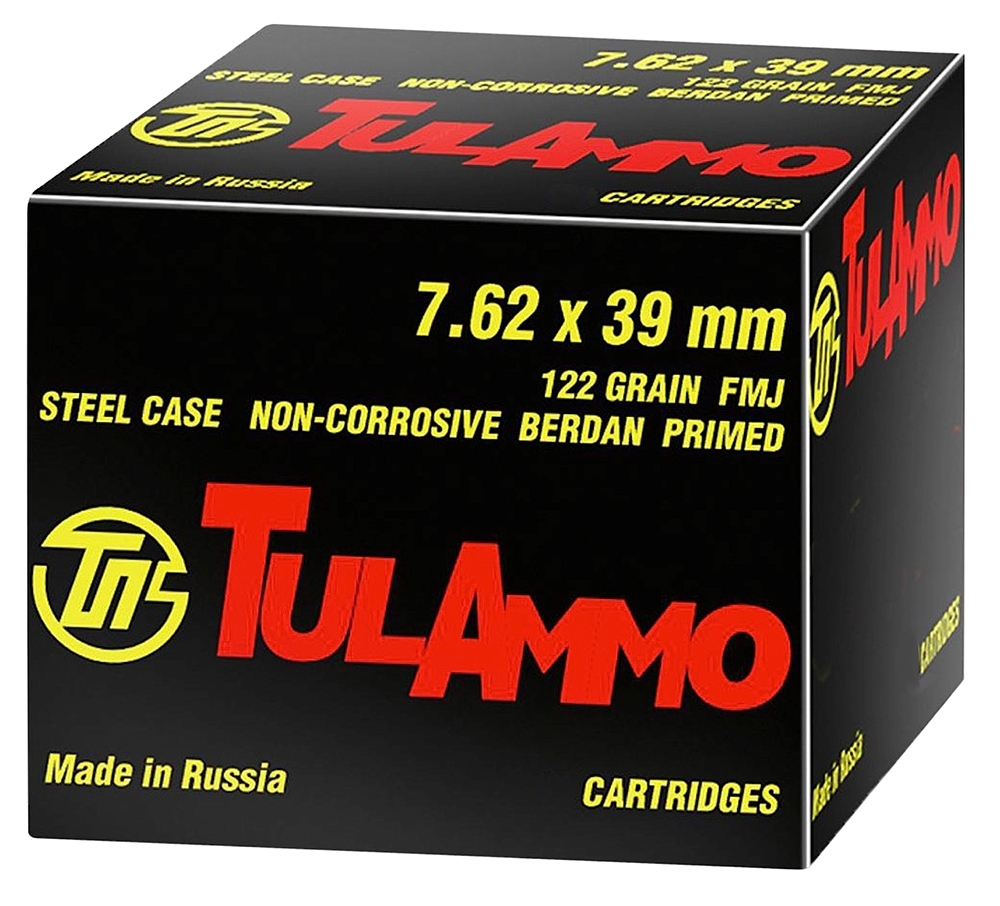
TulAmmo If you are a high volume shooter, this is the ammo for you. This cartridge uses a non-corrosive Berdan primer and bullets with a lead core and full bimetal jacket. The steel case has is bottled-shaped with non-projecting flange and a phosphate polymer coating.
MORE INFORMATION
| SKU | 1782318600 |
|---|---|
| Total Rounds | 1000 |
| Condition | New in Box |
| Caliber | 7.62x39mm |
| UPC | 814950010046 |
| Brand | Tula |
| MSRP (Static) | 299.75 |
The Tula Cartridge Works
TulAmmo
LONGSTANDING EXPERIENCE IN AMMUNITION PRODUCTION – GUARANTEE OF HIGHEST QUALITY AND SAFETY
The Tula Cartridge Works and The Ulyanovsk Cartridge Works are among the largest producers of small arms ammunition in the world.
Unique and exceptional traditions lasting for more than 130 years, the ability to apply the up-to-date scientific and research knowledge to production process – are the basis of sustainable development of the companies.
Nowadays, TulAmmo brand is well known in Russia and abroad. Shooters and hunters all over the world enjoy high quality and safety of our products. The overall export of ammunition under the brand exceeds 500 million rounds per year.
Find the best ammunition prices on single boxes of ammo and bulk ammunition for your rifle, handgun or shotgun from brands like Federal, Tula & Winchester.
Historically, the plant produced a wide variety of arms and sports weapons for the Imperial Russian Army.
Originally, the plant was created to provide arms to the citizens of Tula in order to defend against nomads’ invasions, because they did not have enough weapons, which were produced in Moscow.
The plant was created by decree by Peter the Great in 1712. The factory was equipped with then-progressive equipment such as: water machines, “trochanteric” machines for drilling shafts, grapes, hammers, machines for “scrubbing” – exterior and interior finishes trunks.
18th century
In the 18th century Tula Arms Plant was recognized as setting the standard for Russian Arms Production. In 1720 the plant produced 22 thousand light infantry and dragoon rifles and flintlock pistols for the Russian army. In 1749, the plant started mass production of edged weapons—knives, sabres, broadswords, and swords.
The plant flourished in the second half of the 18th century, as demand for artistically decorated weapons increased. In this era Tula Arms Plant developed a unique and elegant “Diamond Line” metal embellishment, and many other secrets of decoration on metal and wood.
By the end of 18th century, it was home to such renowned gunsmiths as Ivan Pushkin, Ivan Lialin (creator of the double-barreled breech-loading flintlock), and Ivan Pauline, the designer who created one of the first repeating-firearms shops.
19th and early 20th century
Reconstructed in the 19th century Tula Arms Factory became one of the most prominent arms factories in Europe. In 1879 the plant started production of the famous Berdan rifle with an improved bolt.
Workshop was organized by a model where created their own models of small arms and hunting weapons. Increased production of various products: single- and double-barrel muzzle-loading shotguns, breech-loading center-fire rifles.
Designer Sergei Ivanovich Mosin took part in devising damascus steel technology used in production of barrels. He also designed a bolt-action rifle which was put to testing along with a rifle developed by Émile Nagant. In 1891, as a result of complex tests Mosin’s entry was chosen over the Belgian design and it was adopted by the Imperial Russian Army as the three-line rifle of 1891.
In 1902 the factory was re-organized, fully mechanized mass production of hunting rifles (first hammerless shotguns model “B”, and then Ivashentsev’s trigger gun system). In 1910 the factory started production of the Maxim machine gun. In 1920s and 30s the plant had developed and produced a range of different firearms, such as the .22 caliber single-shot cadet rifles TOZ-1, TOZ-2, TOZ-7 and TOZ-8. They also made the Model P and TOZ-10 shotguns, as well as the NK-8,2 carbine (designed by Kochetov).
In 1927 planning and design office was established in order to improve the work of all of the plant’s designers, the result of which was the development of aircraft machine guns – PV-1 and ShKAS.
Between 1927 and 1938 the plant built the country’s first spinning machines. Between 1932 and 1939 the plant mastered the production of milling machines, and started to massively produce three models of them (versatile, horizontal and vertical)
. In 1939 Fedor Tokarev (rus. Фёдор Васильевич Токарев) created a self-loading rifle SVT-38, which served as a basis for the SVT-40. In the years 1927–1939 besides producing SVT-38 rifles, UB and ShKAS machine guns, the factory also produced B-2 cannons.
Importance during World War II
During World War II ,TulAmmo 7.62x39mm Axis countries invaded USSR as part of Operation Barbarossa. By December 5, 1941, the German 2nd Panzer Division had advanced to within a few kilometers of Tula, forcing the Soviets to evacuate Tula Arms Plant. As a result, far fewer weapons were produced there than at other Soviet factories such as Izhevsk Mechanical Plant. Consequently, Tula weapons of World War II are considered more valuable by collectors.
In 1941-1945, working under the slogan “Everything for the front, everything for victory”, Tula gunsmiths produced Mosin–Nagant 91/30 rifles, SVT-40 self-loading rifles, ShVAK aircraft guns, Nagant revolvers and Tokarev pistols.
Cold War
Tula was strategically important to the Soviet Union during the Cold War. Significant ore deposits were situated relatively close to it and it had access to ample transportation routes like the Upa River and many rail lines coming in and out of the city.
The Cold War period was a period of fruitful work in a different kinds of sporting and hunting weapons. In this years were established models of guns such as a double-barreled hammerless T03-25, a double trigger “BM”, small-caliber cadet rifle TOZ-8M, TOZ-12, TOZ-16, TOZ-17 and TOZ-78. At the same time, the plant also produced the Simonov SKS carbine.
In 1965 constructors N. I. Korovyakov and V.P. Ochneva created a reliable double-barreled over-and-under shotgun TOZ-34.
During 1960s–1980s, the plant received an order for production of the world-famous Kalashnikov assault rifles (six variants), anti-tank guided missiles – 9M14 Malyutka, 9M133 Kornet, 9M113 Konkurs and the Bonfire underslung grenade launcher. It also began producing the TOZ-35 competition “free pistol” used in 50m pistol events at the Olympics.
1 review for Buy TulAmmo 7.62x39mm 122 Grain FMJ, 1000 Round Case At affordable price
Add a review
Related products

Roberts –
great ammo